Auto Body and Collision Technician Apprentice
Overview
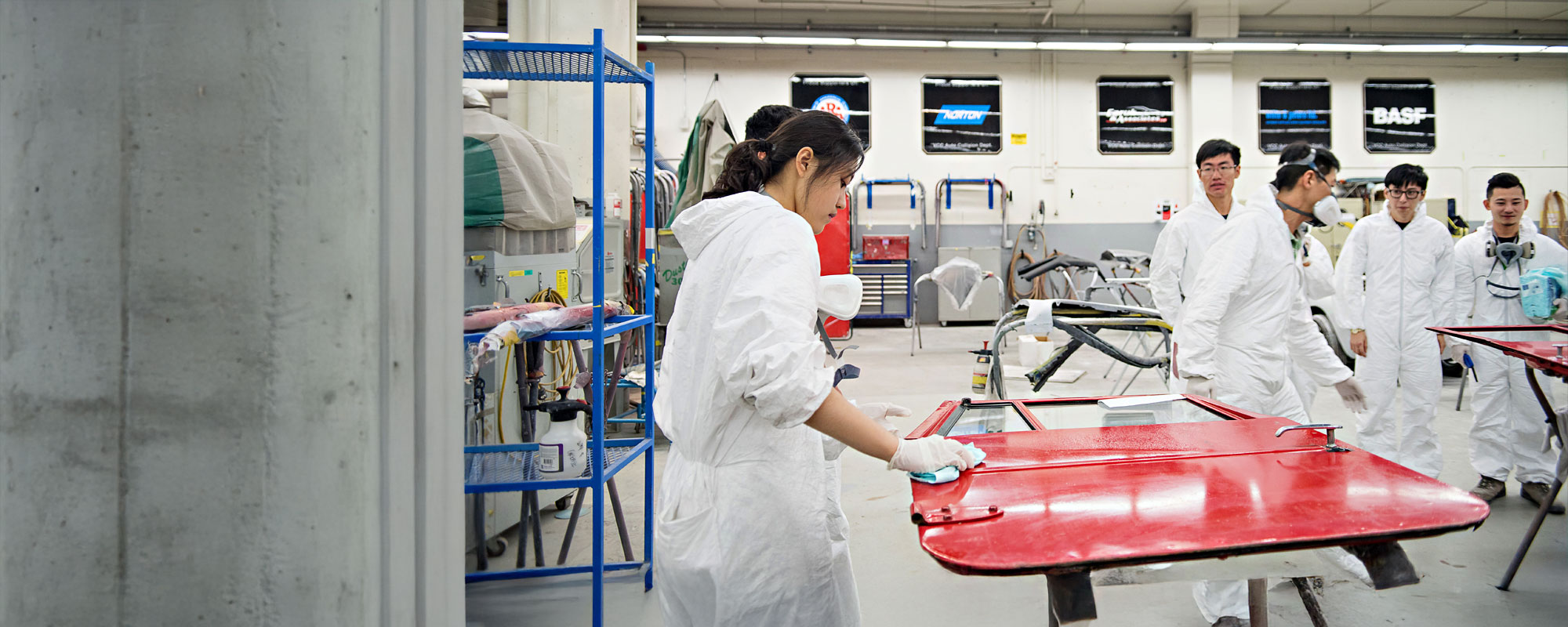
Learn to assess auto body damage and perform industry-standard surface and structural repairs, while working your way up to a B.C. trade certificate.
| Tuition | Per level |
|---|---|
| Credential | Apprenticeship |
| Length | Varies per level |
| Hours | Full-time |
| Delivery | Class-based and Online |
| Campus | Broadway |
What to expect
Courses are offered in on-campus and blended online/on-campus delivery options. Both delivery options may include on-campus, online, and live online (videoconference) components.
Option 1: On campus. On campus courses are offered face-to-face for 6 weeks each level (7 weeks for level 1).
Option 2: Online/On-campus blended. Online/On-campus blended delivery courses are offered online for 16 – 23 weeks, followed by a 2 – 3 week full-time face-to-face on-campus component, depending on the course.
What you will learn
- How to assess body damage and develop repair estimates and repair plans.
- How to repair scratches, minor damage and extensive structural damage.
- How to remove components for access during repairs and replace those damaged beyond repair.
- How to align and replace steering and suspension components.
- How to work with mechanical and electrical components such as air conditioning systems, exhaust systems, drivetrain, engine cooling systems, advanced electronic components and passenger restraint systems.
Program duration and maximum time for completion
The combined duration for all levels of traditional on-campus technical training classes is 25 weeks. See each course for details and for online/on-campus delivery durations. Technical training generally takes 4 years to complete, alongside 6450 hours of work-based training. There is no maximum time to completion.
Admission requirements
Program-specific
- A valid SkilledTradesBC ID number
- A current employer and sponsor.*
NOTE: Registration in the online/on-campus (E-pprentice) courses is recommended only for individuals prepared to meet the demands of an online learning environment. E-pprentice courses require a high level of self-directed engagement, effective time management, and the ability to work independently without in-person supervision. Participants must be proficient in using digital tools, capable of communicating clearly through online platforms, and willing to actively seek support and utilize available resources to ensure academic success.
* Every registered apprentice has both an employer and a sponsor. The employer hires you and pays for your work; the sponsor commits to helping you get opportunities to learn on the job and reports on your progress. In most cases, the employer and sponsor are the same person or organization.
Learn more about VCC's academic upgrading or English as a Second Language (ESL) courses, or discover which university transfer options are right for you.
Recommended considerations
Course activities require:
- frequent lifting and moving of heavy equipment, automotive parts, and materials;
- frequent movement alternating between standing, bending, kneeling and reaching;
- extended periods (5+ hours) of standing/walking on concrete floors/hard surfaces;
- differentiating colours for safety codes, wiring, and automotive paint colour analysis and tinting;
- the operation of automobiles for staging/positioning within the facility;
- precise hand-eye coordination and dexterity. Activities may include the operation of equipment and machines, detailed assembly, and small-scale technical work requiring steady hand movements.
Course environments involve:
- exposure to fumes, dust, and airborne particles from paints, solvents, and mechanical processes;
- exposure to loud machinery noise, power tools, and equipment vibrations;
- exposure to automotive chemicals and strong odors from paint, solvents and additives, cleaning agents, polishing compounds, fuels, oils, lubricants and coolants.
Other considerations include:
- the required use of computers to access web-based course materials, and to complete quizzes and exams;
- following detailed oral and written instruction in the English language.
If you have a disability or diagnosis and think you might face challenges with any of the listed considerations, please contact [email protected] or 604.871.7500 to explore possible accommodations/supports.
Program availability
Not currently available.
Courses
Note: If you have completed ACRP 1101, ACRP 1102, or the Automotive Refinishing Foundation Certificate, you can go directly to Level 2. Each level must be completed in the option you registered for, but you may switch options when starting a new level.
Option 1: On campus
| Code | Title | Credits |
|---|---|---|
| ACRP 1101 | Automotive Collision and Refinish Common Core Apprentice Level 1 | 9 |
or Automotive Collision and Refinishing Foundation Certificate | ||
| ACAP 2002 | Auto Body and Collision Technician Apprentice Level 2 | 8 |
| ACAP 3002 | Auto Body and Collision Technician Apprentice Level 3 | 8 |
| ACAP 4002 | Auto Body and Collision Technician Apprentice Level 4 | 8 |
Option 2: Online/On-campus blended
| Code | Title | Credits |
|---|---|---|
| ACRP 1102 | Automotive Collision & Refinish Common Core Apprentice Lvl 1 (E-pprentice) | 9 |
| ACAP 2003 | Auto Body and Collision Technician Apprentice Level 2 (E-pprentice) | 9 |
| ACAP 3003 | Auto Body and Collision Technician Apprentice Level 3 (E-pprentice) | 9 |
| ACAP 4003 | Auto Body and Collision Technician Apprentice Level 4 (E-pprentice) | 8 |
This information is intended as a guideline only. Program and course details are subject to change with the approval of VCC's Board of Governors.
Fees and costs
| Level 1 |
$1,023
$1,153
|
Online
In-person
|
|---|---|---|
| Level 2 |
$1,023
$1,044
|
Online
In-person
|
| Level 3 |
$1,023
$1,044
|
Online
In-person
|
| Level 4 |
$917
$1,044
|
Online
In-person
|
* Fees are approximate and subject to change with the approval of VCC's Board of Governors. Students are required to pay any applicable fee increases. Application and assessment fees are non-refundable. Tuition fees include a non-refundable deposit.
Refund policies vary for domestic and international students. Review the applicable policy for eligibility, deadlines, and refund amounts.
Need help with tuition?
Explore your options for scholarships, grants, bursaries, and loans.
Technical requirement
How to apply
All apprentice training is open for applications. Go to EducationPlanner BC and apply for the term that is open. You will be able to register in courses starting that term and future terms.
Choose a schedule:
- Automotive Collision and Refinish Common Core Apprentice Level 1 (ACRP 1101)
- Auto Body and Collision Technician Apprentice Level 2 (ACAP 2002)
- Auto Body and Collision Technician Apprentice Level 3 (ACAP 3002)
- Auto Body and Collision Technician Apprentice Level 4 ACAP 4002)
How to register in Apprentice courses
Ready to apply?
Online
You will be directed to EducationPlannerBC.
Fill out a PDF form and mail to:
VCC Registrar's Office
1155 East Broadway
Vancouver, B.C., V5T 4V5
International students
Apply to VCC international programs online. Check the availability status for your desired program and intake before applying.
Contact us
Program information
<p>For questions about apprenticeship programs email us at [email protected].</p>
Advising services
Phone: 604.871.7000, option 2
Email: [email protected]
Advising services for International students
Do you have any questions?